

2025-03-13
Introduction
The hotel industry generates over 6 billion PVC key cards every year. Most last a few days in a guest's pocket, then go in the bin. A standard PVC card takes over 400 years to break down — a fact that used to sit quietly in sustainability reports and is now making its way into procurement conversations.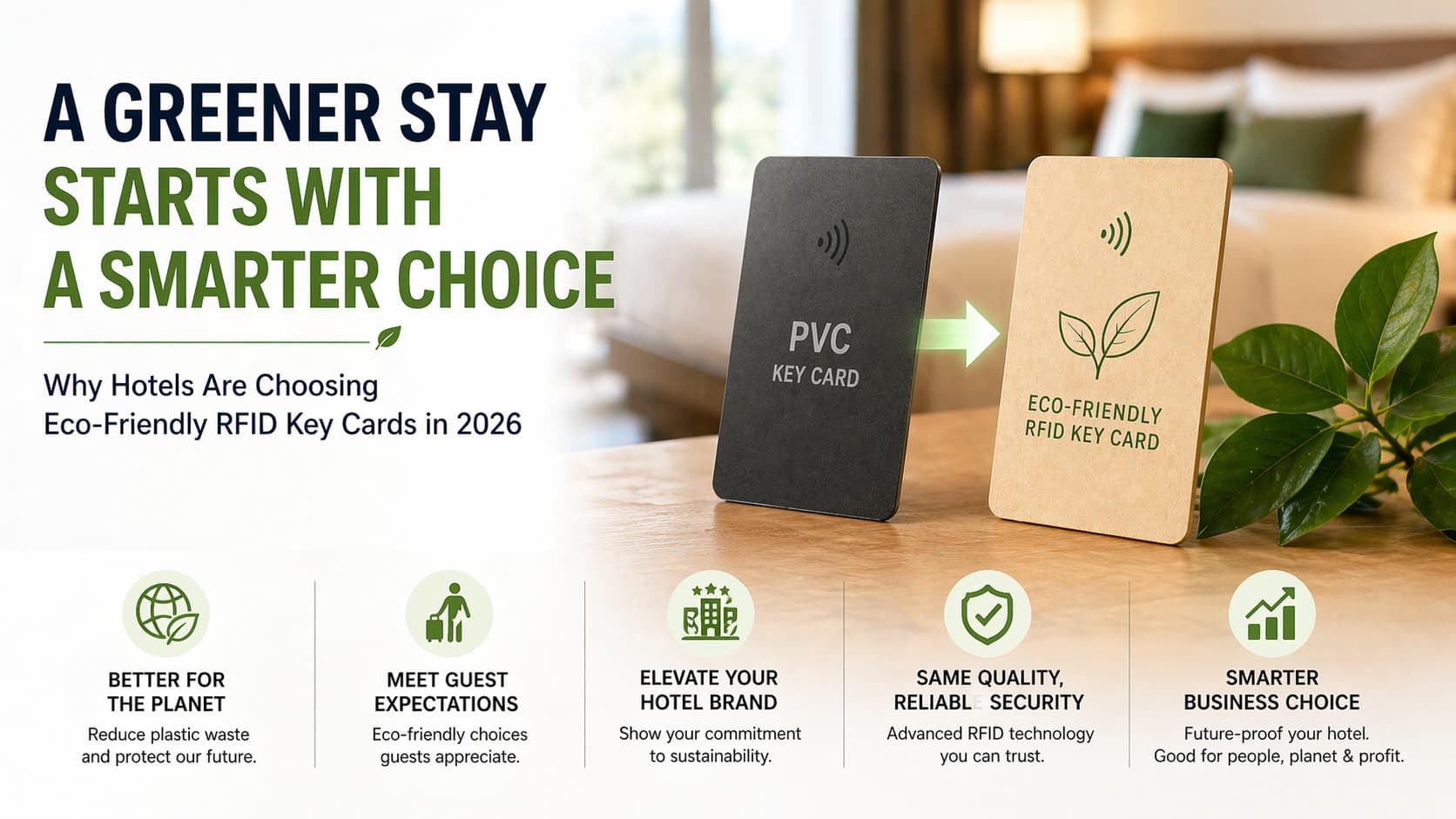
Three Reasons PVC Is Getting Replaced
ESG pressure from above: Marriott, IHG, and other major groups have started pushing sustainability requirements down to suppliers. PVC key cards — disposable, high-volume, non-degradable — are an easy target when procurement teams are looking for wins on single-use plastics.
Guests notice: Boutique hotels and eco-resorts attract guests who pay attention to this stuff. A cheap plastic card handed to someone paying $400 a night creates a small but real moment of friction — one that shows up in reviews more than most operators expect.
Regulation is moving: The EU's single-use plastics rules keep expanding. Similar frameworks are taking shape in parts of the Middle East and Southeast Asia. Getting ahead of a compliance requirement costs less than scrambling to meet one.
| Dimension | PVC | Wood (FSC-Certified) | Bamboo | Paper (Biodegradable Coating) |
|---|---|---|---|---|
| Reference cost per card | $0.15–0.30 | $0.80–1.50 | $0.50–0.90 | $0.20–0.40 |
| Durability | High (5,000+ bends) | Medium-High (3,000+ bends + waterproof coating) | High (4,000+ bends + waterproof coating) | Low (500–1,000 bends) |
| Water resistance | Inherent | Coated | Coated | Limited (with coating treatment) |
| Biodegradation timeline | 400+ years | 2–5 years | 1–3 years | 3–6 months |
| Chip compatibility | MIFARE Classic/DESFire/NTAG | MIFARE Classic/DESFire/NTAG | MIFARE Classic/DESFire/NTAG | MIFARE Classic/NTAG |
| Customization options | Full-color print, embossing, foil | Laser engraving, screen print | Laser engraving, screen print | Full-color print |
| ESG credential | None | Yes (FSC chain-of-custody) | Yes (biodegradable) | Yes (biodegradable) |
| Best-fit property type | Economy, mid-scale chains | Luxury, boutique, eco-resorts | Mid-scale chains, eco brands | Economy, short-stay |
Cost reference based on 500-unit minimum order. All chip options are CR80-compliant and backward-compatible with existing RFID door lock systems.
Luxury and Boutique Hotels → FSC-Certified Wood
Laser-engraved wood produces sharper detail than standard printing and sits naturally alongside the other physical objects in a premium guest room. FSC certification comes with traceable documentation — something procurement teams can drop straight into an ESG report without extra paperwork.
The guest behavior side is worth knowing: wooden cards get kept. Properties that have switched to wood report roughly three times as many guest-generated social posts featuring the card versus plastic — brand visibility without any additional spend.
Cost per card is higher than PVC, but in context of total spend per luxury guest, the premium is small. The brand return is not.
Mid-Scale Chain Hotels → Bamboo
Bamboo grows faster than timber, breaks down faster, and has a lower carbon footprint. On durability and water resistance it's close to wood — but it comes in 30–40% cheaper per card, which matters when you're ordering at volume and replacing cards frequently.
For chain operators who want a credible sustainability story without a budget hit, bamboo is currently the most straightforward swap.
Economy Hotels → Biodegradable Paper Cards
Paper eco-cards cost roughly the same as PVC and meet basic biodegradability standards — enough to satisfy most ESG compliance checkboxes at the lowest possible price point. The limitation is durability: they're built for stays of one to three nights, not extended use. For budget properties not ready to move to premium materials, paper is the lowest-friction starting point.
Changing key card materials isn't a statement — it's a practical procurement decision that touches cost, durability, brand consistency, and compliance at the same time. Every property tier has a sensible option. The risk in staying with PVC is that it keeps accumulating exposure on two fronts — regulatory and reputational — simultaneously.
All four materials work with existing RFID door lock systems. Switching is less disruptive than most procurement teams assume going in.
To request product specifications, material samples, or a custom quotation for your property, contact Shenzhen Chenxin Technology Co., Ltd. (CshinRFID). We supply hotels, resorts, and hospitality brands globally with fully customized RFID key cards — covering chip selection, visual design, and small-to-medium batch delivery.
Website: www.cshinrfid.com
Email: sales@cshinrfid.com
